03Content Strategy · Localization · Taxonomy Design

Unifying naming architecture across Messenger and Instagram

Reconciling two years of fractured, redundant naming across Instagram and Messenger into a single unified taxonomy — localization-ready and built to scale across Meta’s community ecosystem.

Role

I represented Messenger’s community messaging pillar as part of a cross-functional v-team of content designers spanning Instagram and Messenger. While the taxonomy work was collaborative, I owned the naming architecture for my pillar, drove alignment across teams, brokered agreement on shared vocabulary, and led the linguistic audit for my pillar, one of the building blocks of the unified system.
Naming architecture unification project

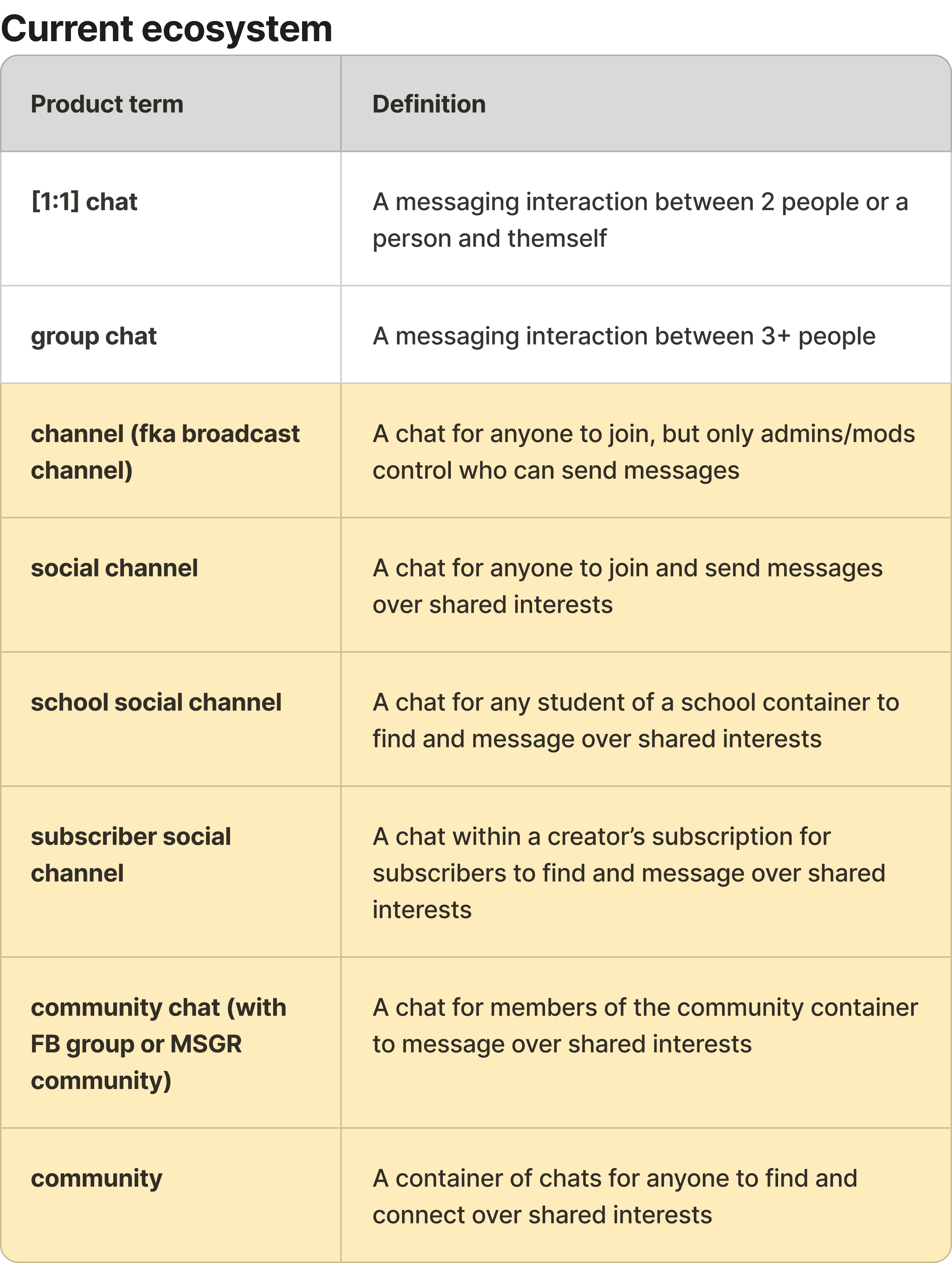
Across Instagram and Messenger, the same feature had accumulated two years of naming debt from independent teams building in parallel. Instagram called it a “social channel.” Messenger called it a “community chat.” The same feature, a space where anyone could join and message over shared interests, had two different names depending on which app you opened.

The problem ran deeper than branding. “Broadcast channel” had been introduced to distinguish one-way from two-way communication, but with “social channel” largely deprecated from the UI, the modifier had become redundant. It localized poorly, confused younger audiences, and created internal misalignment across Product, Engineering, and Legal. Six competing terms, two apps, one product vision, and no shared vocabulary to hold it together.

01

Architecting “community” as a meta-primitive

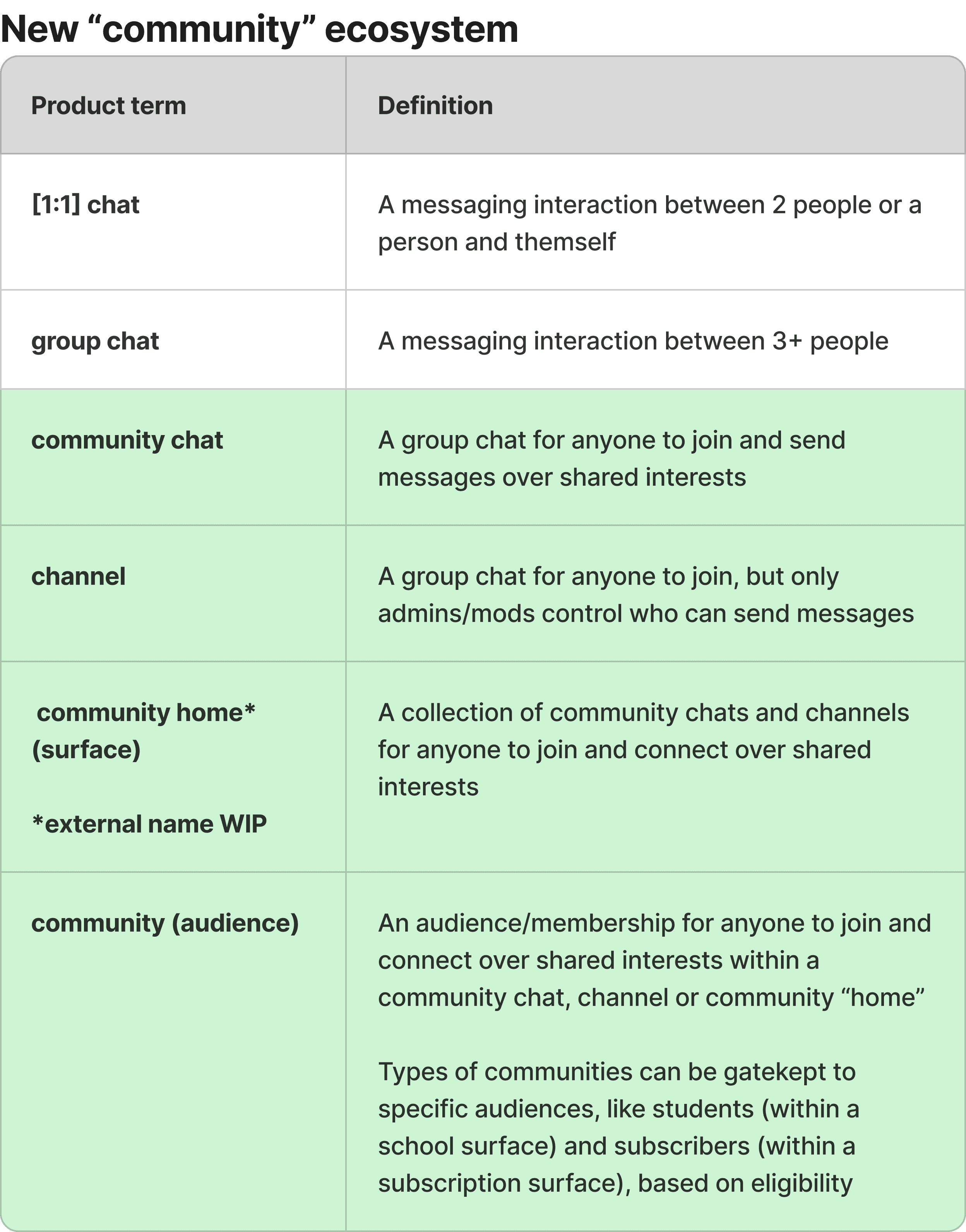
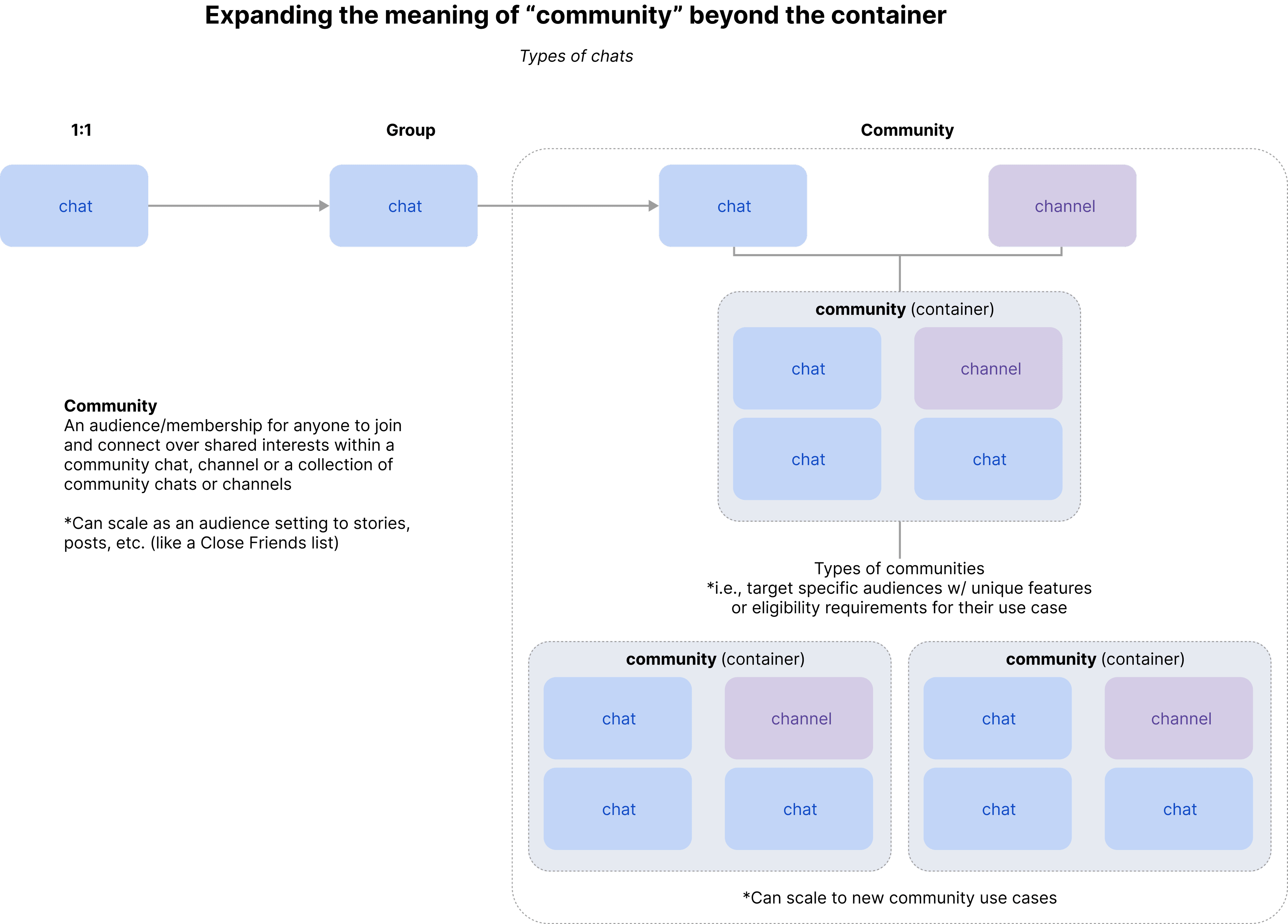
The core problem was structural: “community” meant different things to different teams. I led cross-functional efforts to redefine it not as a UI container but as a shared audience identity: a membership anyone could join around shared interests. This freed social connections to scale across diverse messaging objects without forcing users into a single rigid UI structure.

Architectural diagram showing how community, channel, and chat relate as structural primitives
02

Developing a unified product taxonomy

We each conducted a linguistic audit of our respective product areas to eliminate term drift and redundant naming patterns across both apps, then synthesized findings into a unified taxonomy. The goal was a single source of truth: consistent terms, consistent definitions, consistent behavior — regardless of which app you were in.

Taxonomy reduced from 6 terms to 4

First-ever terminology alignment between Instagram and Messenger for community messaging products

Table showing the fragmented naming taxonomy before the alignment work
Table showing the unified naming taxonomy after the alignment work
03

Future-proofing for new verticals

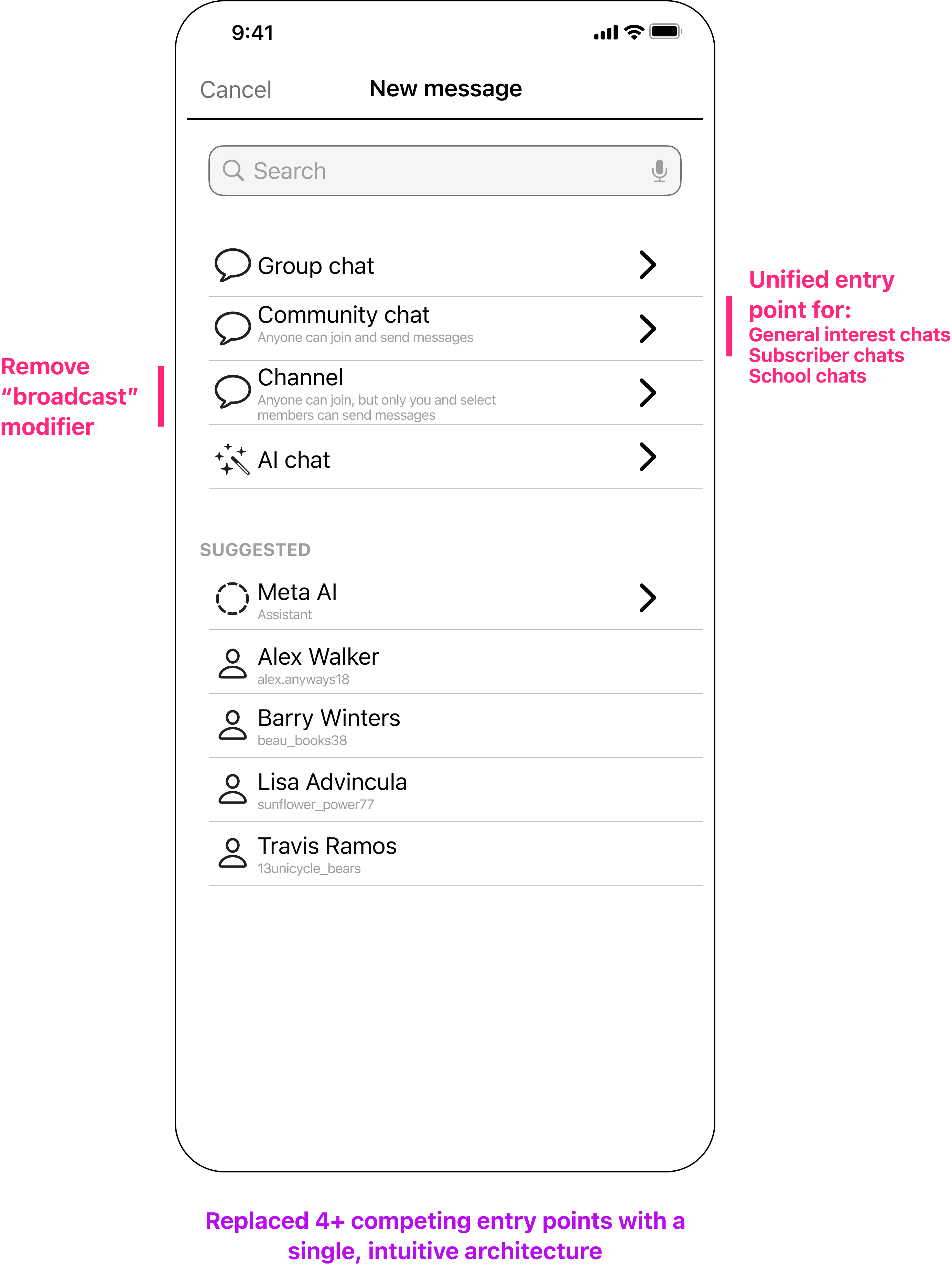
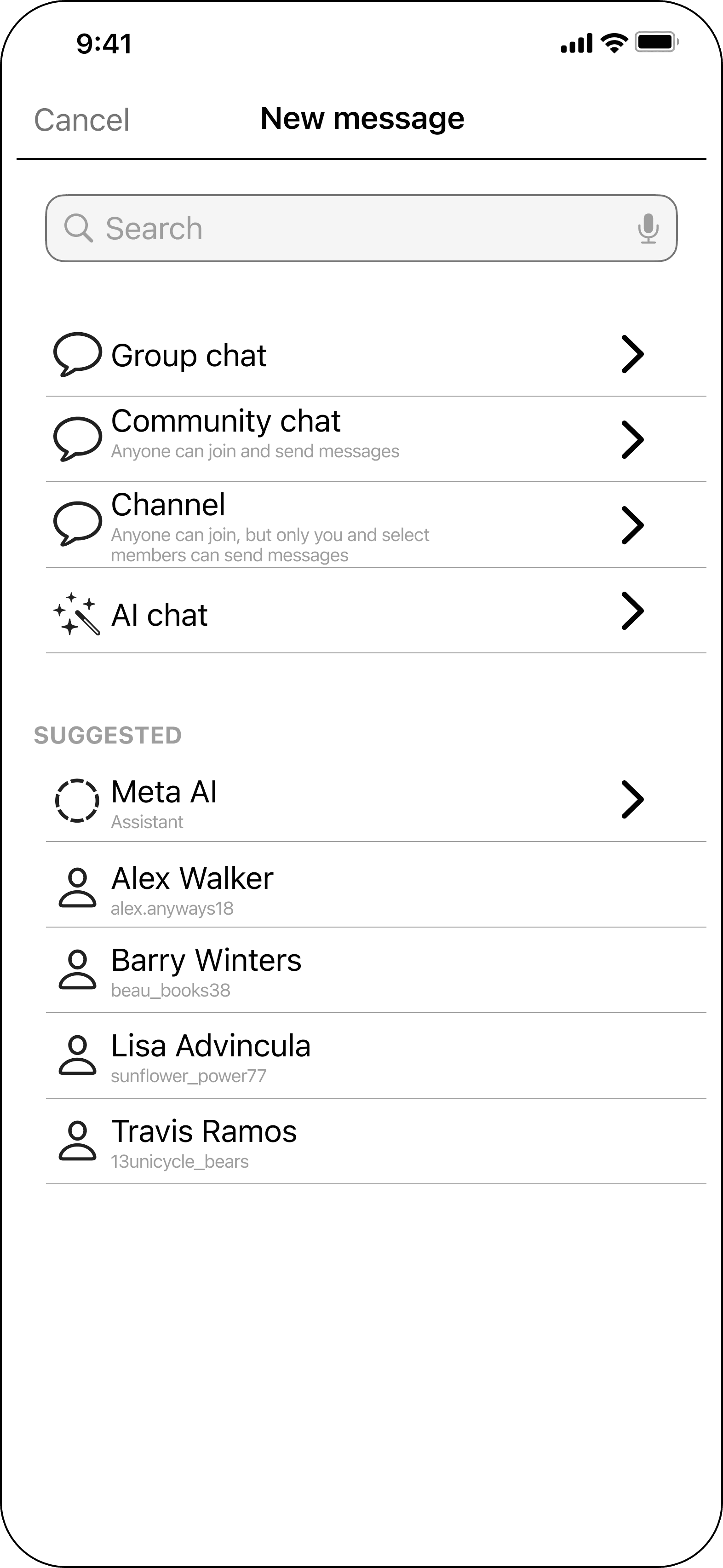
The naming system needed to scale beyond general-interest communities into segment-specific models like schools and subscriptions without requiring new naming conventions each time. I developed proof-of-concept wireframes showing how the naming system could bring greater coherence across Instagram and Messenger while scaling into new verticals, demonstrating extensibility by design, not by exception.

Annotated phone wireframe showing the omnipicker designed to scale naming across new verticals
  • Taxonomy reduced from 6 terms to 4
  • First terminology alignment between Instagram and Messenger for community messaging products
  • “Broadcast” and “social” modifiers eliminated
  • Channel and chat established as core primitives; community as meta-primitive
  • Engineering, Product, and Legal provided a locked term database, reducing naming negotiation cycles
  • Naming system designed to scale into new verticals without future renames

Content Strategy

Localization

Taxonomy Design

Content Design

Cross-app Design

Cross-functional Collaboration

Information Architecture

Nomenclature

Stakeholder Alignment

Systems Thinking